Monday, May 30, 2016

Week 3 - Colombia and Violent Democracies

PART 1. Democracy and Violence; Experiences of Political Violence in Colombia: The FARC, The Paras, and Those In-Between
Associated Readings
  1. Arias and Goldstein, Introductory Chapter: "Violent Pluralism: Understanding Violent Democracies of Latin America," pp. 1-34
  2. Jan Knippers Black and William Godnick, “Colombia's split-level realities,” from Latin America: Its Problems and Its Promise, pp. 381-398 (2011)
  3. Peter Winn, “Perils of the state” from Americas, pp. 495-510 (2006)
  4. Michael Taussig, selections from Law in a Lawless Land: Diary of a Limpieza Campaign in Colombia, pp. 1-34 (2003)
  5. Leslie Gill, “Labor and human rights: ‘The real thing’ in Colombia,” Transforming Anthropology 13, pp. 110-115 (2005)
Handouts ("Course Documents" on Bb)
  1. Handout 2. Colombia - Recent History
  2. Handout 3. Colombia - Plan Colombia
I. Introduction to Colombia (Draws from World Scholar/Latin America & the Caribbean, 2011)
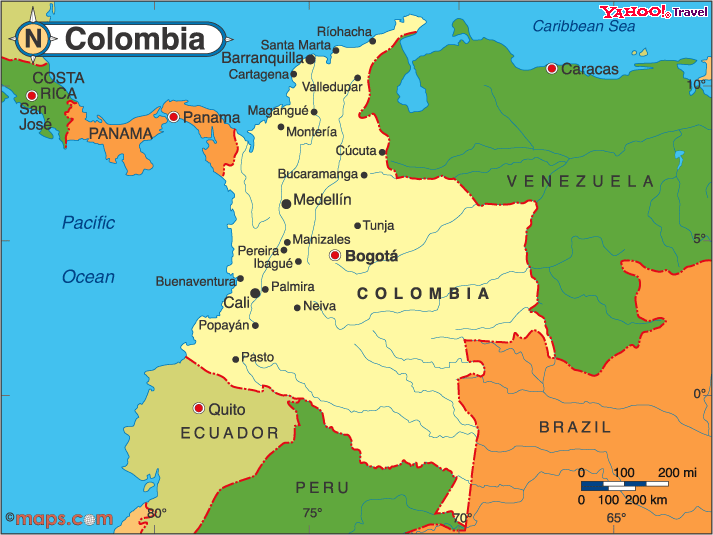
Colombia, the fourth-largest and third-most-populous country in South America, is bordered by Ecuador, Peru, Brazil, Venezuela, and Panama. Its long coastline is split by the Isthmus of Panama between the Pacific Ocean and the Caribbean Sea. The country's coastal plains, where the vast majority of its 44.2 million (2010) people live, give way to rugged mountains and eastern grasslands. Unlike most of the countries we will consider in this course, Colombia has not experienced by an authoritarian regime (for example, a military dictatorship) in recent decades.

Some Colombians you might have heard of:  the pop singer Shakira, the Nobel Prize in Literature winner Gabriel Garcia Marquez (One Hundred Years of Solitude), the Formula One race car driver Juan Pablo Montoyez, and the rock and roll musician Juanes.  Actress Catalina Sandino Moreno was nominated for an Academy Award for her performance in “Maria, Full of Grace,” the story of a young woman who mules drugs from Colombia to New Jersey.  And many know the coffee bean picker Juan Valdez, a fictional character used to promote Colombian coffee. Speaking of coffee, see this recent Washington Post piece on this year's World Barista Championship.

Colombia's colonial history illustrates well the patter described in my Week 2 blog: The first Spanish settlements date to 1510, and by midcentury the foundations for colonial society were established. Thought the encomienda and draft labor systems, indigenous people were forced into something close to slavery; as their numbers dwindled due to disease and desertion, many Africans were enslaved and brought to the colony to fulfill its labor requirements. The colonial economy was based on agriculture and gold mining, supplemented in the seventeenth century by trade. In the eighteenth century, the Spanish Crown created the Viceroyalty of New Granada, centered in the present-day capital, Bogotá. Simón Bolívar defeated the Spanish near Bogotá in 1819, establishing and becoming president of Gran Colombia (comprising contemporary Colombia, Venezuela, Panama, and Ecuador). Following the breakup of this entity by 1832, the foundations were laid for the modern Republic of Colombia.

In the early twentieth century, coffee became the engine of the economy, spurring industrialization and urbanization. Freely elected civilian governments represented both the Liberal and Conservative parties. Interparty rivalry led to an extended period of civil war, known as "La Violencia," between 1948 and 1958, costing some 300,000 lives. In 1957 a power-sharing alliance, the National Front, ended the war; the alliance was phased out by 1974.

The Revolutionary Armed Forces of Colombia (FARC) was established in 1964 as an armed Marxist-Leninist revolutionary movement and has since expanded to gain de-facto control of large portions of rural Colombia. Subsequent governments struggled with terrorist violence by the FARC insurgency and other left-wing guerrilla organizations, drug cartels, and paramilitary forces.

During President Alvaro Uribe's two terms (2002-2010), security improved, with significant gains against drug trafficking and increased military pressure against the FARC guerrillas. Juan Manuel Santos, Uribe's defense minister, became president in 2010.

Despite its ongoing internal political strife, Colombia remains a culturally rich and vibrant country, with a dizzying array of urban landscapes and beautiful rural landscapes.

II. Understanding the Major Players in Colombia's Political Violence

As we begin getting familiar with the theme "political violence" in Colombia, I would like to suggest that you resist the temptation to determine who are the "good guys" and who are the "bad guys."  What makes Colombia so troubling (and so fascinating) is that, at this point in time, it is very difficult to tell who is on whose side and how armed groups official ideologies (which may sound very good) match up to what they actually do (which may sound very bad). Take this suggestion seriously as you read the selections from Michael Taussig's Lawless Land: Diary of a Limpieza Campaign in Colombia.


Prior to moving forward, make sure you have printed out handouts 2 and 3. Look at them from time to time as we move ahead.

In order to understand political violence in Colombia, you need to get familiar with two groups and a government initiative. The two groups are the FARC and the Paras, and the initiative is Plan Colombia. Be aware that Colombians have very strong feelings about these three issue. (If you have any Colombian friends or teachers, you will find out quickly.) Look over this short article to get your feet wet.

Here are short introductions to each of these:
The Revolutionary Armed Forces of Colombia (FARC) was established in 1964 as an armed Marxist-Leninist revolutionary movement. Since its inception, the FARC has been based geographically in the southeastern jungles and in the plains at the base of the Andes. According to its official ideologies, the FARC claims to represent the rural poor in a struggle against Colombia's wealthier classes. It opposes U.S. influence in Colombia (particularly Plan Colombia), and it fights against the privatization of natural resources, against multinational corporations, and against paramilitary violence. The possible appeal of these priorities and principles has been complicated by the FARC's actions, including armed insurgency (guerilla) campaigns against successive Colombian governments (with the goal of seizing power through an armed revolution) and involvement in Colombia's international drug trade. Within the international community, the FARC is considered a terrorist organization due to its well-documented random kidnappings, violence, and human rights abuses.

Paramilitary Forces are groups
whose function and organization are similar to those of a professional military, but which is not considered part of a state's formal armed forces. In Colombia, in recent years several massive paramilitary forces (or, to use the colloquial term, "Paras") have emerged. In the beginning, these groups claimed to be protecting ordinary citizens from insurgent groups like the FARC, since the state police and military was failing to do so. In time, the interests and priorities of the Paras have become much more complicated. An umbrella group you should know about is the United Self-Defense Forces of Colombia (Autodefensas Unidas de Colombia, or "AUC"), which consolidated multiple paramilitary groups into one umbrella organization and presently has somewhere between 10,000 and 25,000 members. Like the FARC, AUC is considered a terrorist organization by multiple countries and organizations, including the United States and the European Union. Also like the FARC, Colombian paras have been linked to drug production and trafficking. Unlike the FARC, they have collaborated with the Colombian police and military and have received funding and support from the government--funding which, at least in part, came from the U.S. via Plan Colombia (see below). Listen to this NPR story on right-wing paramilitaries and the assassination of union leaders. (This is the topic of Leslie Gill's short readings about Coca Cola in Part 2.) 

Plan Colombia. Conceived and implemented in the late 1990s, Plan Colombia emerged out of a series of conversations between Colombia's late-1990s president, Andrés Pastrana, and the U.S. administration of Bill Clinton. For his part, Pastrana was interested in social and economic revitalization, ending the armed conflict and creating an anti-drug strategy; the priorities of the U.S. were counternarcotics projects (following the "War on Drugs" approach), and sustainable economic development projects that would convince coca farmers to grow and market other crops. Having cost us several billion dollars to date, Plan Colombia is the U.S.’s largest military aid initiative outside of the Middle East.

Watch the following two-part documentary on the FARC and the Paras (copy and paste link into your browser): http://youtu.be/SKJblKuj84E


III. Michael Taussig
Michael Taussig is a senior anthropologist and longtime professor on the faculty at Columbia University. Over the years, he's written on variety of themes, including peasants, violence, capitalism, religion, healing and medicine. In his text, based on fieldwork carried out in 2001, one gets a good idea of what life is like in the Colombian countryside, where paranoia and fear of both the FARC and the Paras permeates the consciousness of ordinary citizens. The narrative Taussig tells is chilling, but it is real and, for the most part, is still happening. As you read, attempt to answer these questions:
  1. What is a limpieza campaign?
  2. Who carries them out?
  3. Who are the targets?
IV. Some Updates
Between 2003 and 2006, the Colombian government began a campaign to demobilize the United Self-Defense Forces of Colombia (Autodefensas Unidas de Colombia/AUC), an armed coalition of regional paramilitary groups that had been regularly accused of murder, forced displacement, extortion, and other human rights violations against local populations in their efforts to combat left-wing insurgents in Colombia. Although over 30,000 persons involved in the AUC were disarmed during this controversial campaign, there is growing concern that new paramilitary groups have since emerged, and formerly demobilized paramilitaries are reconstituting themselves as criminal gangs.
 

Despite government efforts at eradication of the coca crop, Colombia remains the world's leading producer of coca, and is a major supplier of cocaine to the U.S. and other international markets. It also produces opium poppy (used in heroin production), although cultivation is estimated to have decreased significantly since 2006, and cannabis (marijuana).
 
The FARC insurgency was weakened in September 2010 when Colombian security forces killed the group's second in command. The bombing raid in a remote mountainous area, coupled with a ground operation, also killed about twenty FARC members.
 
In July 2008, under Operation Jaque, Colombian military commandos succeeded in a dramatic rescue of fifteen FARC hostages, including three U.S. military contractors. Among the hostages was Ingrid Betancourt, a French-Colombian politician who had been held for six years.

PART 2.Democracy, Neoliberalism and Violence


I. Colombia and Neoliberalism
As you know from last week’s blog, Latin American economies were characterized by stagnation and inflation in the 1980s, due in large part to the debt crisis (itself a reflection of the 1973 Oil Crisis). Remember from my Week 2 blog entry that to “rescue” Latin American economies from further implosion (thereby ensuring that debt repayment could resume), international lending institutions like the IMF and World Bank imposed “structural adjustment” policies which enacted austerity measures to slash government budgets, for example, by freezing the wages of government employees and lowering public expenditures for social services such as health and education. Structural adjustment policies also asked Latin American states to increase exports and remove barriers on trade--to reintegrate their national economies, in other words, into the global market. As I have stated earlier, the immediate consequences of structural policies enacted in the 1980s were both positive and negative.  On the one hand, these policies did successfully stabilize many Latin American economies (curtailing skyrocketing inflation rates, for example). On the other hand, the slashing of public social services proved devastating for the quality of life of ordinary citizens. During the 1980s, thus, economies stabilized, but poverty and social inequality deepened.

In Colombia, structural adjustment policies implemented by Colombia’s president Pastrana in the late 1990s cut federal budgets for health care, education and for development programs. While these cuts allowed Colombia to meet its debt repayment obligations to the Work Bank, they triggered a major internal economic and political crisis, exacerbating political violence and the quasi-“civil war” between the FARC, the Paras, and the government police and military.

II. Democracy and Violence
Finally, we introduce a crucial concept from the reading by Desmond Enrique Arias and Daniel Goldstein's chapter--which you should read now if you haven't already. This is the idea that democracy and violence in contemporary Latin America should not be seen as opposing tendencies, but rather inextricably bound together, each dependent on the other. This is a very provocative (and  controversial) assertion, since many social scientists see violence as a carryover from the old days of colonialism, slavery, and domination of indigenous people Arias and Goldstein, in contrast, argue that violence in Latin America is actually quite "modern" since modern democracies depend on violence. As you read the text, see if you can wrap your mind around this idea and think of some examples from the readings above (on Colombia) that might support Arias and Goldstein's thesis.


Tuesday, May 17, 2016

Week 2 - History, Politics, and Economics

PART 1:  Conquest and Colonization in Latin America, 1500-1800

Associated Readings
  1. Peter Bakewell, "Colonial Latin America," from Latin America: Its Problems and Its Promise, pp. 77-85 (2011)
  2. Eduardo Galeano, selections from Open Veins of Latin America: Five Centuries of the Pillage of a Continent, pp. 175-199 (1971)
  3. Harry Sanabria, "Conquest, colonialism, and resistance," The Anthropology of Latin America and the Caribbean, pp. 76-109 (2007)
For the first half of this week's blog, please watch the following online lecture.


PART 2:  The Rise of Neoliberalism

Associated Readings
  1.  Tom Chodor, “The Neoliberal World Order,” pp. 45-64
Introduction
Our goal in the paragraphs that follow is to get familiar with the political-economic paradigm known as “neoliberalism.”  As I will show, neoliberal globalization is the dominant form of globalization in today’s world.  In contemporary South America, neoliberalism is both extremely influential and extremely contested.  As such, it is imperative that we come to an understanding of where neoliberalism comes from, what its characteristic features are, and how it shapes the lives of ordinary South American citizens.

I.  How to Rebuild the World: Modernization Theory’s Vision of Economic Development in the Post-World War II Years (late 1940s/1950s)

A useful place to begin is with the ending of World War II (1939-1945), at which time the victorious nations of the Allied Forces, led by Great Britain, the Soviet Union, and the United States, confronted a daunting question:

How should the great problems of poverty and under-development among the world’s nations be addressed so as to avert another “world war” in the future?

The backdrop for this question was the awareness that economic under-development (especially during the Great Depression) had been a major factor in the social unrest and fascist ideologies that contributed to the war.

Just months before the end of the war, from July 1-22, 1944, the heads of 44 nations met at a resort in New Hampshire known as Bretton Woods to dialogue on the question above and to make financial arrangements for the postwar world after the expected defeat of Germany and Japan.  The agreements that came out of this meeting came to be known as the “Bretton Woods system.”

Before describing the policies and principles of the Bretton Woods system, it is useful to elucidate the ideology that guided them.  This was an ideology known as modernization theory (also known as “development theory”), which dominated Bretton Woods and, more generally, discussions among policymakers and academics at the time.  Despite its name, modernization theory isn’t so much one single theory as a particular understanding of how poverty and underdevelopment in the world should be addressed.  Modernization theory divided the world into ‘modern’ and ‘traditional’ societies (so-called “First-” and “Third-world” countries).  It held that traditional societies will become modern through industrialization and market expansion.  Moreover, modernization theory emphasized the capacity of unrestricted trade across national borders to promote economic stability and therefore political peace. In other words, the modernization of a poor country entails opening its economy to the world market through imports and exports.

But since poor countries did not have financial resources available for this type of development, how could “modernization” move forward?  The answer:  low-interest, long-term repayment loans.  And it was the Bretton Woods accord that led to the creation of global economic lending institutions--funded and controlled by wealthy nations--that would made these loans available.  Bretton Woods set up two lending institutions:  the World Bank and the International Monetary Fund (or “IMF”).  (In fact, Bretton Woods set up other lending institutions as well--I am condensing this story to convey the key points.)  The World Bank and the IMF were set up to make capital available to the governments of under-developed countries.  Government leaders were encouraged to borrow money from international lending agencies like the IMF to modernize their economies.  These massive loans were typically approved for large-scale “infrastructure” projects--projects like hydroelectric dams and highway systems--which would make possible industrial development.  One well-known example of a public works project funded through a World Bank loan in the 1960s was the Akosombo Dam in Ghana (Africa).

In Latin America, government leaders quickly took advantage of IMF and World Bank loans in order to "modernize" their economies, such that by the late 1970s, these countries had accumulated gargantuan debts.  The following chart, which only represents World Bank loans, gives you an idea of the scale we are talking about:


If you are familiar with the efforts of U2 frontman Bono to organize around debt relief, you will be interested to know that most these debts were incurred under IMF and World Bank loans guided by modernization theory and promoted under the Bretton Woods system.  You can see a short news clip about Bono's efforts here:


II. Emergent Critiques of the Modernization Paradigm: Dependency Theory (1960s)

While dominant in post-War economic planning, the modernization theory paradigm did not go uncontested.  Its strongest challenge came from a set of ideas known as dependency theory.  Developed by social scientists from both poor and wealthy countries, dependency theory fundamentally questioned whose interests the modernization paradigm really served.  Rather than helping poor countries ascend to economic prosperity through investment with IMF- and World Bank loans, dependency theorists argued that modernization programs were in fact a rationalization of the ongoing exploitation by nations at the “core” of the world capitalist system of nations at the “periphery”--namely, exploitation by Europe and the U.S. of poor countries in the southern hemisphere.  According to dependency theorists, the huge debts poor countries were accruing in the name of “modernization” wouldn’t rescue them from under-development--At best, it would help create new markets for products and services provided by wealthy nations.  At worst, indebted nations with limited resources to ever pay off their debts would remain in a state of permanent dependence on wealthy nations.

As you can see, then, dependency theory takes a very cynical view of the promises of modernization theory.


Instead of taking out huge IMF and World Bank loans to develop export- and import-oriented economies, dependency theorists called for a different strategy for development.  This strategy was known as import substitution industrialization or “ISI” and from the 1960s through the 1980s it provided a formidable alternative to strategies promoted under modernization theory.  Rather than depending on the importation of foreign products, the proponents of ISI encouraged poor countries to develop what they needed within their own national boundaries.  They should, in other words, develop locally produced substitutes for goods and services that they had been importing.  This was, in effect, a call for poor countries to close off their economies from the global market (strategies often referred to as “economic nationalism” or "protectionism").

One of the most famous and influential dependency theorists is the Uruguayan journalist Eduardo Galeano, whose work you have read recently.  Can you see reflections of dependency theory as outlined above in the selections you have read from Galeano’s 1973 publication, Open Veins of Latin America?  Watch the clip below to get a clearer sense of this extraordinary thinker and writer:


III. Political Crisis and Economic Consequences in Latin America

In the 1960s and 1970s, many Latin American countries, notably Brazil, Argentina, and Mexico, borrowed huge sums of money from international creditors for industrialization projects.  These were massive infrastructure projects called for by modernization theorists.  For a time, these investments seemed to be paying off, as the countries which had taken out loans saw expanding economies and growing gross national products.  (In Brazil, for example, the late 1960s saw such incredible economic expansion that the period came to be called an “economic miracle.”)  Thus, creditors like the IMF and the World Bank were happy to continue providing new loans.  To give you an idea of the scale of borrowing that took place:  Between 1975 and 1982, Latin American debt increased at a cumulative annual rate of 20.4 percent. This heightened borrowing led Latin America to quadruple its external debt from $75 billion in 1975 to more than $315 billion in 1983, or 50 percent of the region's gross domestic product (GDP).  In other words, by the early 1980s, most Latin American governments were using more than half of their available funds to pay off their debt!

The promise of modernization initiatives shown in the 1960s and early 1970s came to a devastating halt in the late 1970s and 1980s.  These were years of economic stagnation and inflation for nearly all of Latin America.  Why did this happen?  The answer is complicated--and contested by scholars--but most would agree that the economic crisis that befell Latin America in the 1970s had much to do with its vulnerability to unexpected fluctuations in the global market.

To understand what sorts of fluctuations took place and why, you need to know about the 1973 Oil Crisis.  Watch this short clip, from NBC news coverage at the time, to get a better idea:

As you can see, the crisis reflected the ongoing tensions of the Arab-Israeli conflict in the Middle East and began when members of the Organization of Petroleum Exporting Countries (OPEC) announced that they would no longer sell oil to countries supporting Israel.  Eventually, OPEC retreated on this position, but raised the price of oil on the global market.  Since we are now living through a moment of ever-increasing gas prices (I filled my tank yesterday, on May 27, 2011, for $4.09 a gallon!), you can imagine how increases in the price of crude oil (from which gasoline is made) on the international market stalls economic growth and translates into social hardship for ordinary citizens.  Now imagine just how much worse the consequences of the Oil Crisis were in poor countries bound to expensive economic modernization projects and focused on imports and exports.  Due to the crisis, Latin American countries were receiving less for their exported products.  And worse, it was becoming increasingly difficult for governments to keep up with their debt repayments to the IMF, the World Bank, and other lending institutions.  Under these conditions, inflation rose and Latin America’s economies stagnated, devastating ordinary people who could no longer afford to pay for basic necessities like food and shelter for themselves or their families.

Latin America’s growing economic crisis reached a critical moment in 1982 when Mexico defaulted on its IMF loan repayment.  At the time, Mexico owed billions to the IMF, but its leaders said in effect, “Our government does not have enough money available for us to make our monthly payment. We cannot pay you.”  What would happen next?  Mexico was bound by the terms of its loan agreements to pay its debts to the IMF (and for years had nearly crippled itself trying to do just that).  And yet, the IMF couldn’t simply continue demanding repayment since this would risk pushing Latin America’s economies past a point of possible recovery.  If other Latin American states began to default, a domino effect could take place, leaving the continent in precisely the situation that Bretton Woods sought to prevent.

IV. Responses to Economic Crisis and the Origins of Neoliberalism:  Structural Adjustment

The IMFs response to Mexico’s 1982 loan default--and to the economic crisis in Latin America more generally--was a set of policies known as structural adjustment.  The fundamental aim of structural adjustment was to redirect economic development throughout the region in such a way that governments would soon be able to resume debt repayment.  This meant finding ways governments could save money, and to this end, structural adjustment policies slashed government budgets, for example, freezing the wages of government employees and lowering public expenditures for social services such as health and education.  Structural adjustment policies also asked Latin American states to increase exports and remove barriers on trade--to reintegrate their national economies, in other words, into the global market.

The immediate consequences of structural policies enacted in the 1980s were both positive and negative.  On the one hand, these policies did successfully stabilize many Latin American economies (curtailing skyrocketing inflation rates, for example).  On the other hand, the slashing of public social services proved devastating for the quality of life of ordinary citizens.  During the 1980s, thus, economies stabilized, but poverty and social inequality deepened.


It was these structural adjustment policies, devised and enacted in the 1980s, that formed the template for what would later be called "neoliberalism."

V. Codifying Neoliberal Policy: The Washington Consensus

By the late 1980s, there was broad agreement among the leadership of wealthy nations, the IMF, and the World Bank that the principles and policies of structural adjustment were the best way to ensure a stable economic future for Latin America--and therefore the timely repayment of outstanding debts.  In 1989, these principles were codified into a doctrine known as the “Washington Consensus” which, like structural adjustment, emphasized market reforms to aid in the recovery of Latin American economies from the 1980s crises.  To stabilize economies, these reforms included cost-cutting measures, required governments to balance their budgets, and deregulated (“liberalized”) trade.  Part of this deregulation included welcoming foreign investors--encouraging foreign companies to set up factories and production facilities, for example.  To help governments save money, state-owned enterprises (for example, state-owned oil and gas companies, or telephone service providers) would be “privatized,” that is, sold to private corporations (sometimes foreign-owned).

Since the policies and principles of the Washington Consensus emphasize a new formulation of “liberal” economics--emphasizing trade deregulation and foreign investment--they have been called neoliberalism.  And, since the 1980s, neoliberalism has emerged as the dominant economic paradigm embraced by Latin American governments.

It is useful to think of neoliberalism in two ways.  First, we can understand it in economic terms.  Borrowing from the assigned reading by Lynn Phillips, we can view neoliberalism as a shift from inward-looking strategies of development promoting national self-sufficiency to outward-looking free trade aimed at total integration into the world market.  Several of the countries we’ll cover in the weeks to come--Bolivia, Brazil, and Venezuela, most famously--will reject the outward-looking approach of neoliberalism.

We can also think of neoliberalism as an ideology about human happiness and well-being, rooted in faith in the marketplace.  From the neoliberal perspective, in a free-market society, people will have greater individual freedom, flexibility, and choice.

Final Thoughts for This Week


Whether neoliberalism has been good or bad for Latin America remains hotly disputed among academics and policymakers.  Supporters argue that neoliberalism has helped stabilize economies and has provided ordinary Latin Americans with access to a range of new products and opportunities.  Critics, however, argue that neoliberalism puts the Latin American worker in an economically exploitative position, compromises national self-sufficiency and self-determination (“sovereignty”), and limits people’s ability to maintain control over their ways of life and even over their modes of thought.


I'll end on a provocative note.  Since in the United States, we tend to treat the benefits of free market economics as self-evident (that is, as obviously the best option), it is useful to challenge this position with a counter viewpoint.  The short video below comes from lefty journalist Naomi Klein, who considers "neoliberalism" here in the United States.  Consider her critique of neoliberal approaches followed in the aftermath of Hurricane Katrina.  Do you agree?  You have a chance to express your viewpoints in this week's Discussion Forum.


[END OF POSTING]

Week 1 - Geography, Political Democratization, and Recent Turns to the Left

NOTE: Before you get started, install Google Earth on your computer.  Using Google Earth, try to find the various places mentioned in the text below.

Associated Readings
  1. Harry Sanabria, “Introducing Latin America and the Caribbean,” from The Anthropology of Latin America and the Caribbean, pp. 17-49 (2007)
  2. Peter Smith, “A tale of two presidents,” from Democracy in Latin America, pp. 1-15 (2005)
PART 1:  GEOGRAPHY
Why does this map look funny?
Where is South America and is it the same thing as “Latin America”?  The answers to these two questions, it turns out, are not so simple.  In part, this is because here in the United States, we often use the terms inaccurately and inconsistently.  To be fair, most U.S. citizens haven’t traveled to Latin America, so we might not expect them (that is, us) to know Latin American geography that well.  Still, there is a lingering--and troubling--tendency to think of anything south of the Mexican border as South America.  At best, this lumping together conceals the extraordinary cultural, linguistic, geological, and historical diversity of the territories south of the U.S.   At worst, it implies a moral judgement:  that "south" somehow implies less than, inferior to, beneath, etc.  From that perspective, one of the reasons the map above looks "funny" is because it places us below them.

Well, let's first think about what the term "Latin America" refers to.  First, a geo-political definition:

Latin America refers to all independent countries south of the United States, namely, Mexico and the nations of Central America.

According to this definition, "Latin America" looks like the following:


This is useful, but now let's consider a linguistic approach to defining this region.  Instead of geopolitical borders, let's define Latin America as

the sub-region of the Americas where languages derivative of Latin are spoken.

There are only two such languages that are widely spoken in this part of the world, and they are Spanish and Portuguese. Spanish, as you probably know, is spoken in most Latin American countries, while Portuguese is only spoken in Brazil.  In the map below, Spanish is in green and Portuguese is in orange:


As you can see, there are a few countries with other colors:  In Guyana and Suriname, for example, the official language is English, while the citizens of French Guyana speak--no surprise--French.

The linguistic approach gets more complicated if we consider not just official national languages, but all of the languages that are spoken in this world area.  As it turns out, there are more than 900 "living languages" spoken in this region, as illustrated well on this map.  As you can see, if we limit "Latin America" to people who primarily speak either Spanish or Portuguese, we are excluding huge areas and countless communities.

And then there's the matter of the Caribbean.  As a region primarily consisting in island nations sharing similar geography and histories of colonization, some have argued that the Caribbean should not be lumped together with Latin America.  Others, however, have argued that Spanish--the official language of many Caribbean nations--culturally unites the region with Spanish-speaking countries of "mainland" Latin America.  But then again, not all of the mainland countries speak Spanish (hello, Brazil)--and for that matter, neither do all Caribbean nations speak Spanish (hello, Jamaica).

As you can see, designating world areas like "Latin America" is complicated, and may involve exclude certain people, certain language speakers, and/or certain geographic areas.  (Have a close look at Sanabria's discussion of these terms (pp. 19-22), especially whether we use the terms to connote "space" or "place.")  This all points to the need to be precise when we define the the area focus for our course. Let's do that now.

For our course, we'll define South America in both geopolitical and linguistic terms terms.  First, the geopolitical definition:

South America is a continent forming the southern landmass of the Americas.  (Among historians, the Americas are often referred to as "The New World.")  South America begins below Panama and extends down to the southernmost tip of Chile.

Here's a map:

Also have a look at this map.

The countries making up the southernmost section of South America--Argentina, Brazil, Chile, Paraguay, and Uruguay--make up the so-called Southern Cone.  This geographic region corresponds to an important economic free trade zone, known as MercoSur.  (All of the preceding countries except Chile are members of MercoSur.)

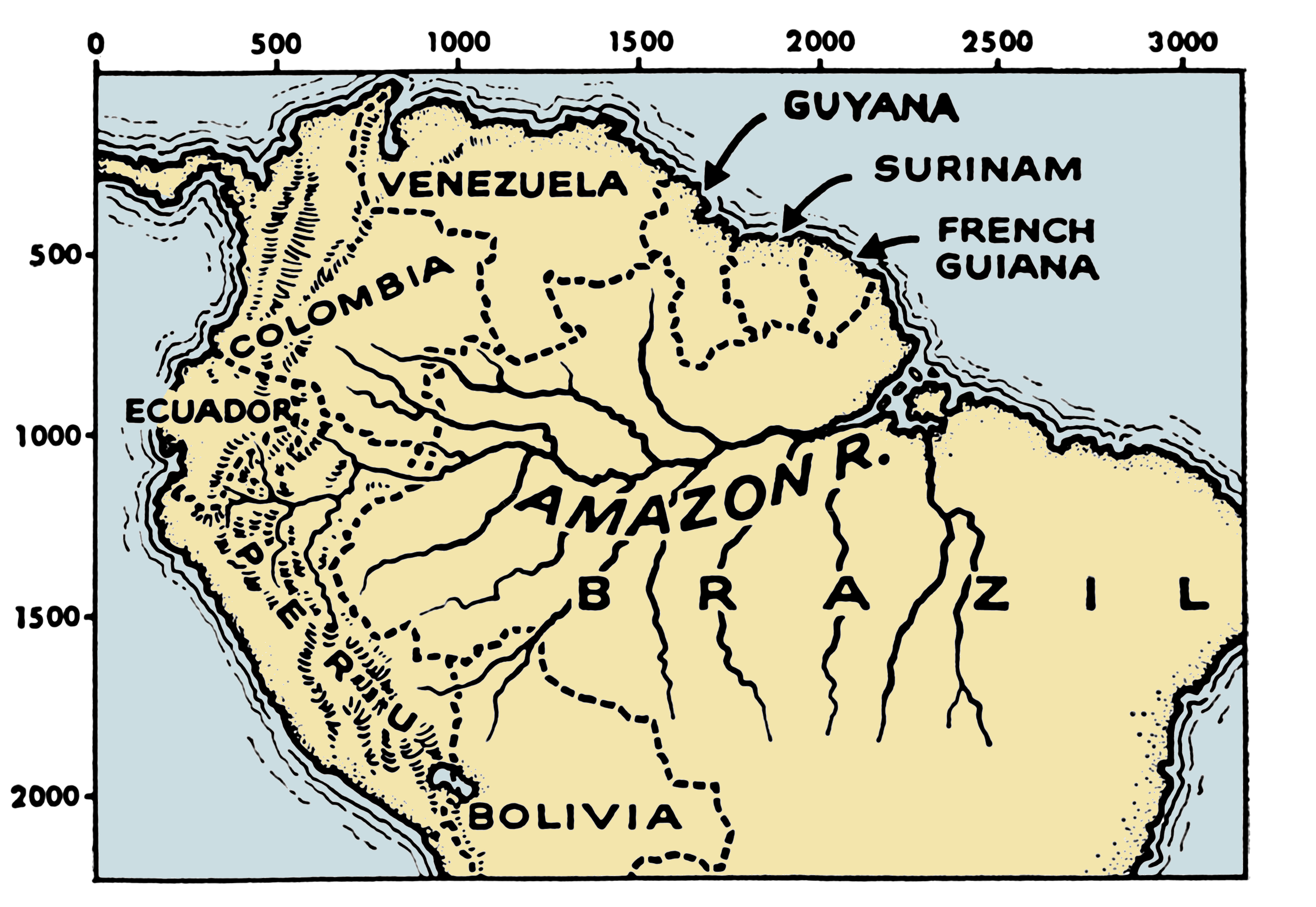
But our geopolitical definition needs to be refined in a linguistic direction since our class will only consider countries where Spanish or Portuguese are the national language.  (Apologies to Guyana, Suriname, and French Guyana!)  In fact, our class will focus primarily on five South American countries:  Argentina, Bolivia, Brazil, Colombia and Venezuela.  (Apologies to Chile, Ecuador, Paraguay, and Peru!)

Characteristics of South America
Now that we know what part of the world we'll focus on, let's learn more about the geographic features of South America. Here are some important facts about South America:
  1. It is situated entirely in the Western Hemisphere and mostly in the Southern Hemisphere.
  2. It is bordered on the west by the Pacific Ocean and on the north and east by the Atlantic Ocean.
  3. North America and the Caribbean Sea lie to the northwest of South America.
    According to the United Nations, as of 2010, approximately 393,221,391 people live in South America.  (Compare this to the 2010 U.S. population: 308,745,538.)
  4. Compared to other continents, South America ranks fourth in landmass size (after Asia, Africa, and North America) and fifth in population (after Asia, Africa, Europe, and North America).
  5. South America is 1.8 times as large as the United States.
Here are some additional factoids about South America.  As you look at the links, see if you can also find each spot on Google Earth.

South America is home to...
  1. the world's highest waterfall, Angel Falls in Venezuela
  2. the largest river (by volume), the Amazon River
  3. the longest mountain range, the Andes
    the largest rainforest, the Amazon Rainforest
  4. the highest railroad, Ticlio, Peru 
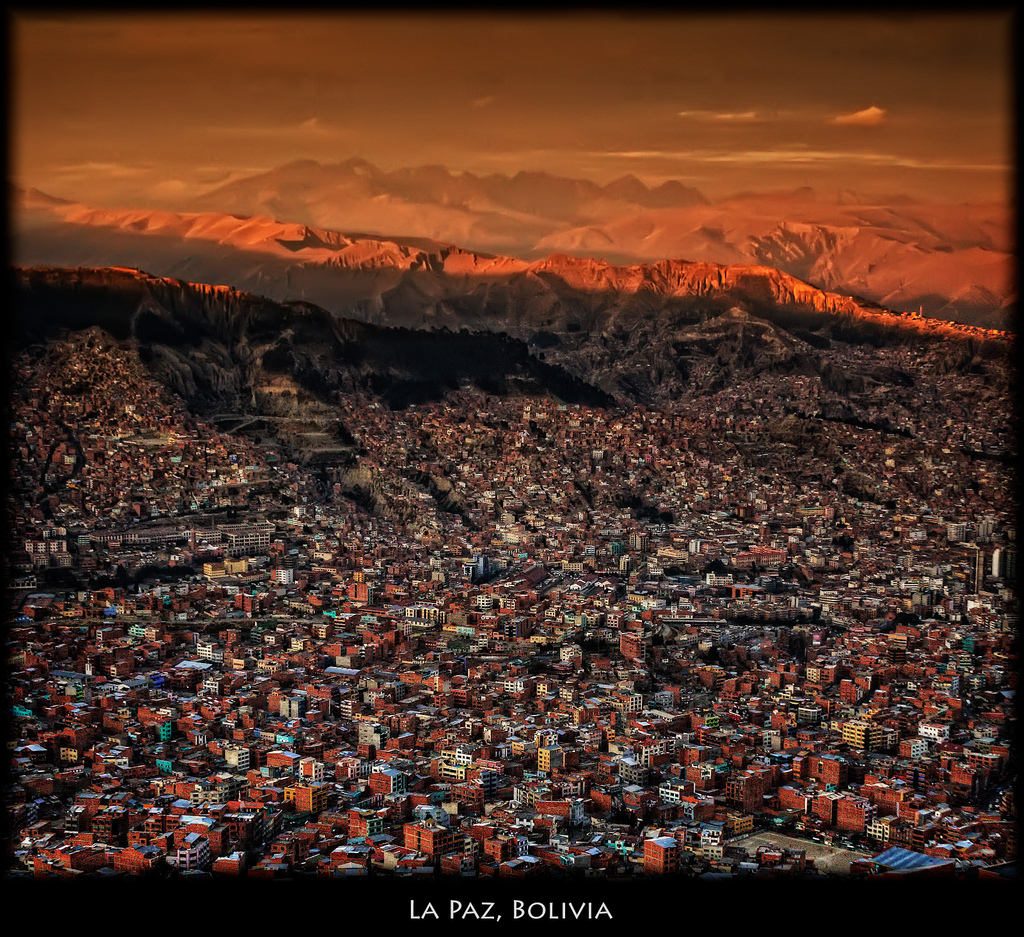
  5. the highest capital city, La Paz, Bolivia 
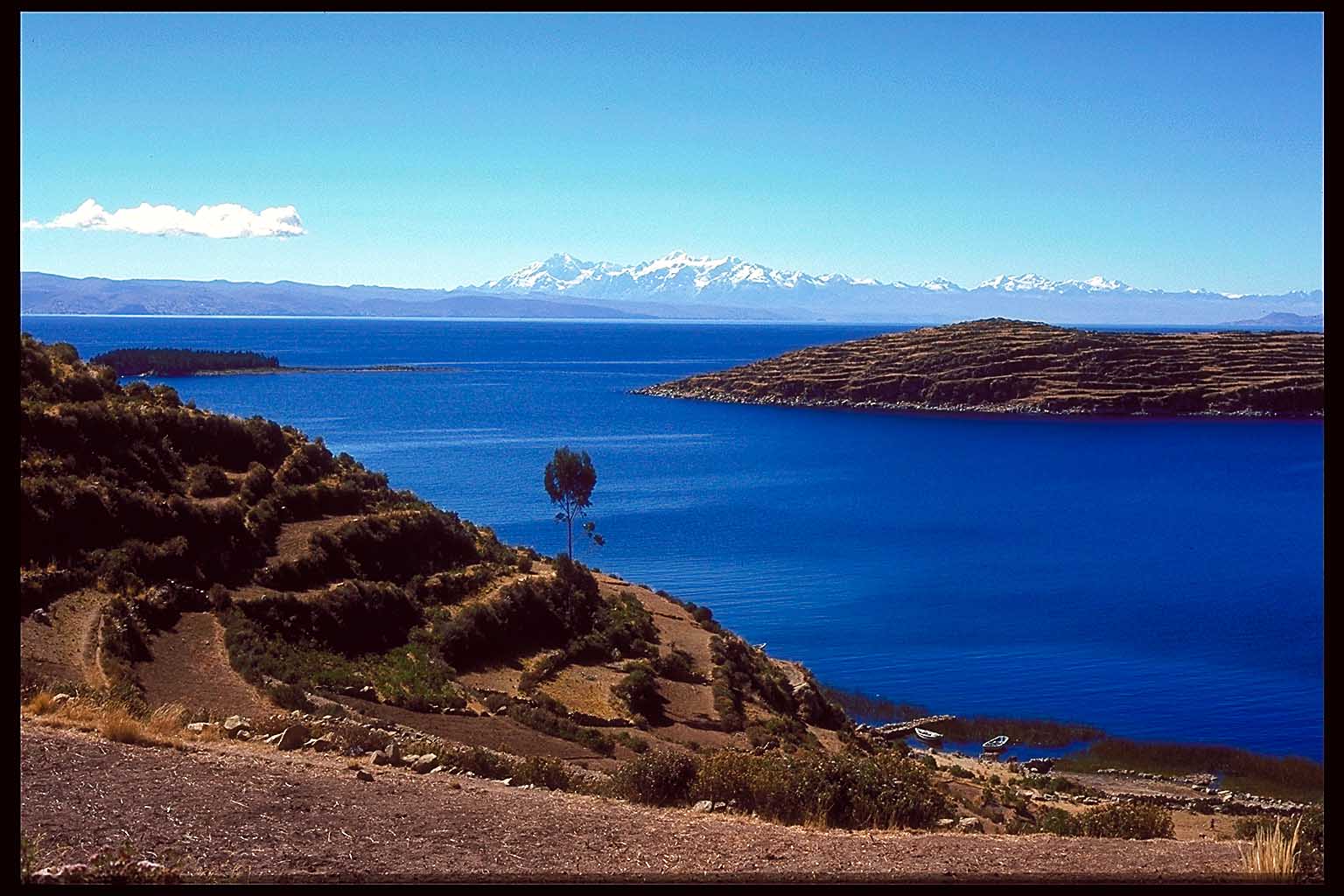
  6. the highest commercially navigable lake in the world, Lake Titicaca 
  7. the world's southernmost town, Puerto Toro, Chile
Rivers and Mountains
South America is characterized by two dominant physical characteristics:  mountain ranges and river systems

The major mountain range is the Andes.  Running down the western edge of the continent, the Andes are the longest and second highest chain of mountains in the world.  From their northernmost tip in Colombia to their southernmost ending in Chile, they run more than 4,300 miles and average around 13,000 feet.  Many of the highest peaks are over 20,000 feet!  Historically, the Andes have also posed impassible barriers to travel, trade, and communication.  Even today, there are very few large highways or trains that connect the large cities on South America's west coast with those of the central highlands.

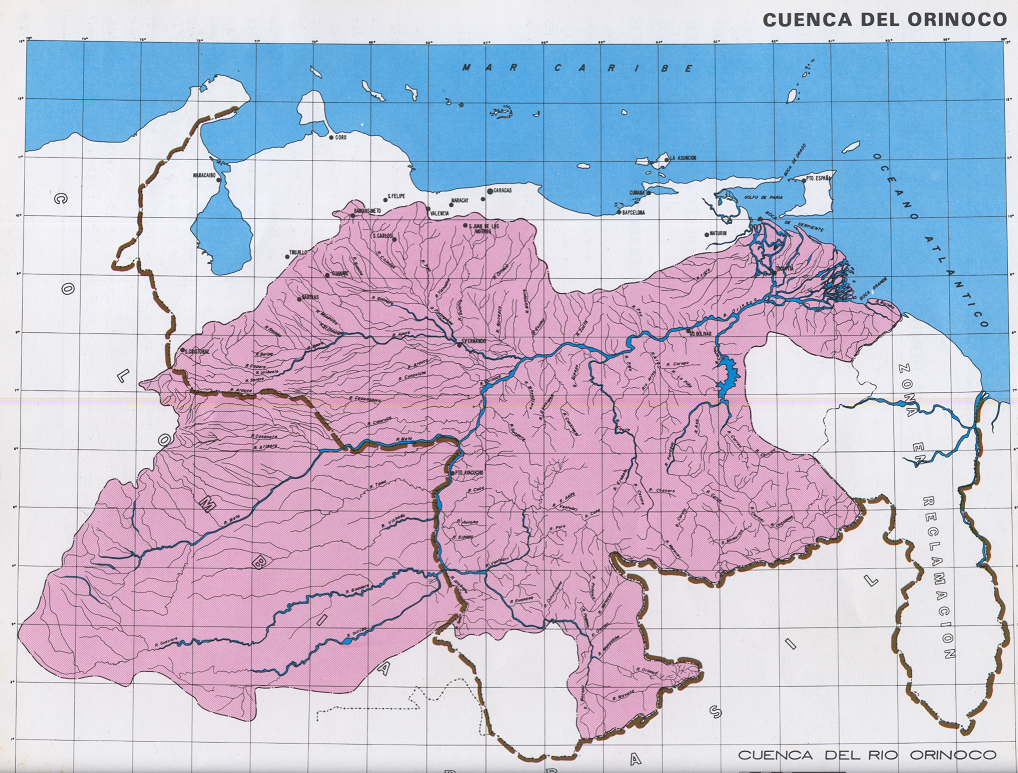
The Andes feed three river systems, each enormous in their own right:
  1. The Amazon, which holds a fifth of the world's fresh water and produces a fifth of the world's oxygen.  (It's not for nothing that some call the Amazon "the lungs of the world"...although not everyone agrees with this label)
  2. The Venezuelan Orinoco river system (you might recognize this)
  3. The Rio de la Plata, which empties at the coastline intersection of Argentina and Uruguay.
 In terms of climate, South America has five major climatological zones:
  1. high mountains (principally, the Andes)
  2. tropical jungles (principally the Amazon)
  3. deserts (eastern Patagonia in Argentina, the arid Atacama desert in Peru, and the Brazilian sertão, see p. 31 of Sanabria)
  4. temperate coastal plains
  5. temperate highlands
An important point: 
The vast majority of South American citizens live in 4 and 5, that is, temperate coastal plains and temperate highlands.

Also, a note about the coasts of South America:  The continent's west coast is mostly characterized by steep mountainsides since it is the western side of the Andes mountain range.  Since it's relatively difficult to build a city on a steep incline, there aren't very many large urban centers on South America's western coastline.  The capitals of Chile and Peru, Santiago and Lima, are important exceptions.  South America's west coast, in contrast, is much more hospitable to the construction of large cities (especially port cities such as Belém at the mouth of the Amazon river).

Sanabria provides a useful explanation of South America's ten physiographic regions (pp.32-38).  Be sure to learn these, as we'll use them throughout the course.

Peoples:  Some Useful Terms

Broadly speaking, we can classify the ancestry of South America's residents into three categories:  indigenous, African, and European.  In contemporary South American societies, many people have mixed ancestries, and so it is useful to introduce the following two terms:
Mestizo:  a mixture of indigenous and European ancestry
Mulatto:  a mixture of African and European ancestry

PART 2:  POLITICAL TRANSFORMATIONS
About 15 years ago, a stunning shift became apparent in the types of presidents South American voters were electing to lead them.  Increasingly, presidents from the political left were winning office.  While our course is not about national politics per se, we are nonetheless concerned with how ordinary citizens understand their countries' pasts and possible futures--so it is worthwhile to get familiar with recent political trends in this part of the world.

First, let's back up the claim that South American countries have been electing leftist presidents, most on the tails of lengthy periods of dictatorship.  Here are the biggies from the past decade -- all leftist and in the case of the three on top "hard left":


In Peter Smith's reading, he compares Brazil's Luiz Inácio Lula da Silva (AKA "Lula") to Venezuela's Hugo Chávez.  Lula on the one hand is a former metalworker and union organizer with little formal education -- a working-class president.  Chávez, on the other hand, is a career military officer who tried to overthrow the government in the 1990s before being elected in 2004.

Let's get more familiar with Lula, elected in 2002 and in office for two terms until 2010, and with Bolivia's current president, Aymará Indian and former coca farmer Evo Morales, elected in 2005.

First Lula.  Watch this short dispatch from 2004 by New York Times journalist, on the rise of Lula and some of the reasons for his mass appeal to Brazil's poor.

Next Morales.  This 2005 dispatch comes from New York Times and Washington Post journalist, Juan Forero.  Forero was in Bolivia, covering the home stretch of the presidential election campaigns which would eventually lead to Morales' election.  Please read Forero's short article now, and then watch his short dispatch.

As you can see, Lula, Morales, and Chávez have a lot of differences in terms of their personal backgrounds, ethnic, and class identities.  (As we move forward in the course, we'll learn a lot more about these differences.)  But they also share several core commitments (at least what they say are their commitments).  So here is a short and much simplified list of official ideological commitments of contemporary leftist presidents in South America:
  1. Reducing poverty
  2. Social welfare (health, education, hunger)
  3. The rights of minority populations, principally, indigenous people, women, rural peasants, people of African descent, and lesbian/gay/bisexual/transgender (LGBT) people
  4. Economic development but while protecting national economies from the world market
  5. The establishment of a Regional Trade Zone -- like MercoSur, but for all of South America or even all of Latin America.
As we move forward, we'll see how these ideas play out "on the ground" in our five case countries.